.png)




IVL Report
Floor owners and other stakeholders in the industry do not always recognize that floor renovation is a viable alternative to installing new flooring. Perfectly good floors are thrown out and replaced with new, sometimes inferior floors, resulting in waste of materials and resources. In the modern world where resources and energy are becoming scarcer and impact on the climate is increasing, the full extent of the consequences – in terms of cost, energy use and climate effects – needs to be methodically evaluated and taken into consideration.
Important Factors
-
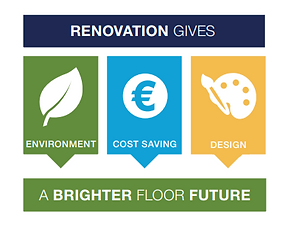
Save Energy and Emissions
-
Cost Control
-
Design Possibilities

Purpose
Floor owners and industry stakeholders often dismiss renovation, discarding usable floors for new ones and wasting valuable resources. In an era of growing resource scarcity and climate concerns, this practice—and its costs, energy use, and environmental impact—must be reconsidered.
Part 1 - Life Cycle Assessment
The first part of the report reviews the environmental impact from refinishing hardwood and resilient flooring by performing a life cycle assessment. The LCA maps out the impact that various processes have on a product level. It determines if there could be a differentiation in carbon footprint and energy resources spent when comparing the production and installation of a new floor with a refinishing of an existing floor. This includes evaluating all life cycle stages including; material production, manufacturing, use and maintenance, and end-of-life.
Part 2 - Roadmap for Sustainable Flooring
A roadmap was also conducted in order to take the industry from the current to the desired situation i.e. reducing greenhouse gas emissions and improving resource use by increasing the number of floors that are refinished. This was done by identifying several barriers and factors in the surrounding environment that affect the business. The roadmap outlined areas for further development and concretized actions that stakeholders in the industry need to work on together to continue the journey towards a resource efficient and circular future.

The LCA studies and evaluates the environmental impact related to a product or a system during its whole life cycle – from cradle to grave. This includes evaluating energy and resource use as well as emissions like CO², generated from all life cycle stages including; material production, manufacturing, use and maintenance, and end-of-life.
The Results - Renovation Makes a Difference
LCA clearly shows that the floor renovation process uses significantly less energy resources and has a much lower environmental impact compared to floor replacement, in relation to both carbon dioxide footprint and in energy use. Up to 90% savings in carbon dioxide footprint and up to 95% savings in energy resources consumed in favour of the refinishing process compared to ripping out the old floor and installing a new one. The result is used as proof of concept that floor refinishing can reduce the impact on climate change and minimize resource use compared to producing and installing new flooring
Saving the Climate and Energy
The study reported that when it comes to wooden floors, the carbon footprint is reduced by 78% when renovating rather than replacing. Renovating resilient floors can reduce the carbon footprint by up to 92% compared to replacing the floors. In addition, we found that by renovating hardwood or resilient floors, at least 90% of resources can be saved, including transportation, electricity, consumables and materials.
.png)
By renovating a floor rather than installing a new one, the energy savings are as high as 95%. Let’s take Bona’s yearly production of floor finishes and calculate the m2 of floors they cover. If new floors were installed instead on same amount of floor surface, the energy use would have been 1.8 billion kWh more*! In comparison, these savings correspond to the yearly energy use of 9,000 households** or a small Swedish town!
Floor renovation saves up to 90% in reduced carbon footprint vs installing a new floor. If we look at Bona’s yearly production of floor finishes and calculate the m2 of floors they cover, the carbon footprint reduction per m2 vs. new floors is 108,000 tonnes CO2 . This is equal to CO2 emissions from 9,600 flights around the world

Direct and indirect cost savings
When you add it up, renovation makes a significant difference, from many perspectives. As the calculations show, in addition to supporting the planet by reducing carbon dioxide footprint and use of energy resources, there are also cost advantages to be gained from renovating rather than replacing a floor.
Renovating also allows you to restore the existing floor to its initial beauty or give it a whole new look, based on modern flooring trends. Finally, renovation even makes your floor more hygienic, as the monolithic surface ensures an easy cleaned and maintained floor, preventing build-up of microorganisms.


When comparing costs for renovated floor with a new installation, it is important to consider all actions involved. The square metre cost of new floor is only one part of an installation calculation, so to make a fair calculation comparison you need to include labour costs for ripping out the existing floor, preparation of subfloor, removing and re-mounting skirting boards etc.
Plank-by-plank, a renovation of a wood floor works out to be at least 40% less expensive compared to installing a new floor to replace the existing one.

The same cost savings applies to resilient floors, when comparing costs for actions that need to be considered for both renovation and installation, in order to make a relevant cost comparison. In terms of resilient floors, the total cost is reduced by at least 41%.
There is also a saving of roughly 60% in time, which means that profitability for the contractor increases by an impressive 70%!